Choosing a builder
How to choose a builder in Mallorca: 10 questions to ask before you sign
To choose a builder in Mallorca, ask each company the same ten questions and get whatever it promises in writing: registration with the REA (Spain’s register of accredited construction companies), an itemised quote, how changes are handled, the schedule, guarantees, insurance and what happens after handover.
At a glance
- Every company working on a building project, subcontractors included, must be registered with the REA, a public register that can be checked online (Ley 32/2006).
- In the Balearic Islands, if you are a private client, the quote for building work is given in writing and broken down, and it binds the company as soon as you accept it in writing (Ley 7/2014).
- Spain’s Building Act (Ley de Ordenación de la Edificación, LOE) sets 10 years of liability for the structure, 3 for habitability and 1 for finishes, from the formal acceptance of the works.
- The Project Manager coordinates the project and controls costs, but does not replace the site management team (dirección facultativa).
Knowing how to choose a builder in Mallorca has less to do with price than with what each company is prepared to sign up to. Two quotes with the same total can describe different projects, and the difference only comes to light once you have signed. This guide sets out the questions to ask a builder before you do; we have written it from the other side of the table, as the people who answer those questions.
How to choose a builder in Mallorca: compare answers, not just prices
Ask every company the same ten questions and have the important answers written into the quote or the contract: that way you compare like with like and know who is responsible for what. If you are still looking for a plot, start with what to check when buying land in Mallorca to build on.
Is the builder registered with the REA, and who will carry out the work?
Every company hired or subcontracted on a construction project must be registered with the Register of Accredited Companies (Registro de Empresas Acreditadas, REA), under art. 4 of the Construction Subcontracting Act (Ley 32/2006 de subcontratación en el sector de la construcción). The register is public and can be searched on the Ministry of Labour website using the company’s tax ID (CIF) or its registration number.
The law also limits the length of the subcontracting chain: the third subcontractor in line and self-employed workers cannot subcontract any further (art. 5), and you, as the client (promotor), can consult the project’s subcontracting log, the Libro de Subcontratación (art. 8). Nor does subcontracting dilute responsibility: under art. 17.6 of Spain’s Building Act (Ley 38/1999 de Ordenación de la Edificación, LOE), the builder is directly liable for defects in the work carried out by its subcontractors.
The answer to expect: its REA number, the name of the site manager (jefe de obra) and which work it will subcontract. Top Mallorca Constructions, for example, is listed under REA no. 04/01/0016272: in the search, choose “REA” as the identifier type and enter that number.
What does the builder’s quote include, and what does it leave out?
A quote you can compare is itemised, with each line item showing its measured quantity and unit price. In the Balearic Islands, if you are hiring as a private individual, the Balearic Consumer Protection Act (Ley 7/2014 de protección de las personas consumidoras de las Illes Balears) requires it to be given in writing, with the final price broken down and taxes included. Unless it states another period, it is valid for at least 15 calendar days, and once accepted in writing it is binding (art. 18).
What most often skews a comparison is what has been left out. Ask whether the quote includes:
- the fees of the architect and the building engineer (aparejador);
- the building permit (licencia de obra) and the ICIO construction tax, which we explain in our guide to building permits in Mallorca;
- waste management and utility connections;
- the pool and the garden;
- VAT (IVA).
Ask, too, whether the price is fixed. Under the Spanish Civil Code (Código Civil), a contractor who takes on a job for a lump sum (ajuste alzado) to an agreed plan cannot ask for more even if wages or materials go up, except for changes that you authorise (art. 1593).
The answer to expect: line items with measured quantities and exclusions, all in writing. That is how Top Mallorca prices its work, so that you know what each figure covers.
How does the builder handle changes during the works?
Almost every cost overrun starts with a change. In the Balearic Islands, changes to the quote are only binding if you accept them in writing (Ley 7/2014, art. 18), and increasing the quote without your prior consent is a consumer protection offence (art. 81).
What you are looking for is a procedure, not a promise: each change is priced together with its effect on the timescale, you approve it in writing, and only then is it carried out. Ask for the building contract to set this out, together with a schedule of variations showing at all times how far the project has moved away from the original quote.
The answer to expect: that procedure, in writing and before work starts. This is Top Mallorca’s rule: no change goes ahead until it has been priced and approved in writing.
What schedule and what delay penalties will the builder sign up to?
A deadline without consequences is only a forecast. If the contract sets a penalty for delay, that amount replaces compensation for damages unless otherwise agreed, and a court can reduce it if the work was partly completed (Civil Code, arts. 1152 and 1154).
The schedule also has to allow for the season. In July and August, building sites in Calvià that exceed the noise limits may only work from 10:30 am to 1 pm in the tourist areas and in Calvià Vila and Es Capdellà (Calvià noise by-law, BOIB, the Official Gazette of the Balearic Islands, 8 June 2024). We explain the stages of a new house in our guide to building a house in Mallorca.
Payments should follow the work: when there is an architect’s design (proyecto), interim certificates are signed by the site management team (LOE, arts. 12 and 13), so paying against certificates means paying for work actually done. And nothing in cash: cash payments to a business are prohibited for amounts of €1,000 or more, or €10,000 or more if you pay as a private individual with no tax domicile in Spain (Ley 7/2012, art. 7).
The answer to expect: a phased schedule with milestones and a capped penalty, with payments tied to certified work. Ask, too, what happens to the deadline if the delay is caused by the permit or by a change you have asked for.
What guarantees come with a new build or a renovation, and when do they start?
The guarantees on a construction project depend on whether the law classes it as building work (edificación). A new house is, and so is a renovation that substantially alters the building, such as an extension or a change of use (LOE, art. 2). In those cases, liability runs for 10 years for structural damage and 3 years for habitability defects; the builder is also liable for finishes for 1 year. All of these periods run from the formal acceptance of the works (art. 17), and a claim becomes time-barred two years after the damage appears (art. 18).
A partial renovation, such as a kitchen or a bathroom that leaves the structure untouched, has no statutory guarantee period of its own: Spain’s General Consumer Protection Act (Real Decreto Legislativo 1/2007) excludes services from its guarantee rules (art. 114). Products, however, are covered for three years (art. 120), and breach of contract can be claimed for five (Civil Code, art. 1964).
The answer to expect: the commercial guarantee in writing, with its duration and scope. Some contracts also provide for a 5% retention of the construction cost (ejecución material) during the one-year finishes period, as the LOE allows (art. 19).
Who will be your point of contact, and how will the builder keep you informed?
Many parties are involved in a build, from the architect to the last tradesperson, and if no one answers for all of them, you end up coordinating them yourself. That matters even more if you do not live on the island. In the Balearic Islands, 32.27% of home purchases in the second quarter of 2026 were made by foreign buyers, the highest share in Spain, according to the Spanish Land Registrars’ Association (Colegio de Registradores).
If you are looking for a builder that works for non-residents, “we’ll keep you informed” is not enough. Ask the company to specify:
- who your point of contact is, besides the site manager;
- how often you will receive written progress updates with photos;
- how site visits will work when you are not there;
- which language the reports will be in.
The answer to expect: a named person and progress updates on set dates. That is how Top Mallorca works: a single point of contact and remote updates for owners who live elsewhere. And if you want to delegate the entire management of the project, that is what Project Management in Mallorca is for: someone who coordinates the project and controls costs and deadlines on your behalf.
Will the builder work with your architect and the site management team?
It has to, because the builder does not direct the works. For homes, the design is signed by an architect, and the works are directed by a site director (director de obra), also an architect, and a director of works execution (director de ejecución), who is a building engineer: together they form the site management team (LOE, arts. 10 to 13). The builder carries out the work in accordance with the design and the directors’ instructions (art. 11).
And the Project Manager? The LOE does not devote a single article to the role: the Project Manager’s obligations are those set out in their contract (art. 8). They coordinate the project and control costs on the owner’s behalf, but do not replace the site management team, which is the body that signs the final completion certificate, the certificado final de obra (art. 6).
The answer to expect: that it builds to designs by outside architects and works with the site management team throughout the build. Top Mallorca works with the client’s architect or, if the client does not have one yet, suggests qualified professionals.
What projects like yours has the builder completed, and can you see them?
A photo gallery shows the result, not how the build went. Ask for two or three projects comparable to yours in type and size and, ideally, in your municipality, because every town council has its own rules and timescales. If you can, talk to the owner and ask whether the build came in on budget and how unforeseen issues were resolved. Visiting a site in progress also helps: within a few minutes you can see how well organised it is.
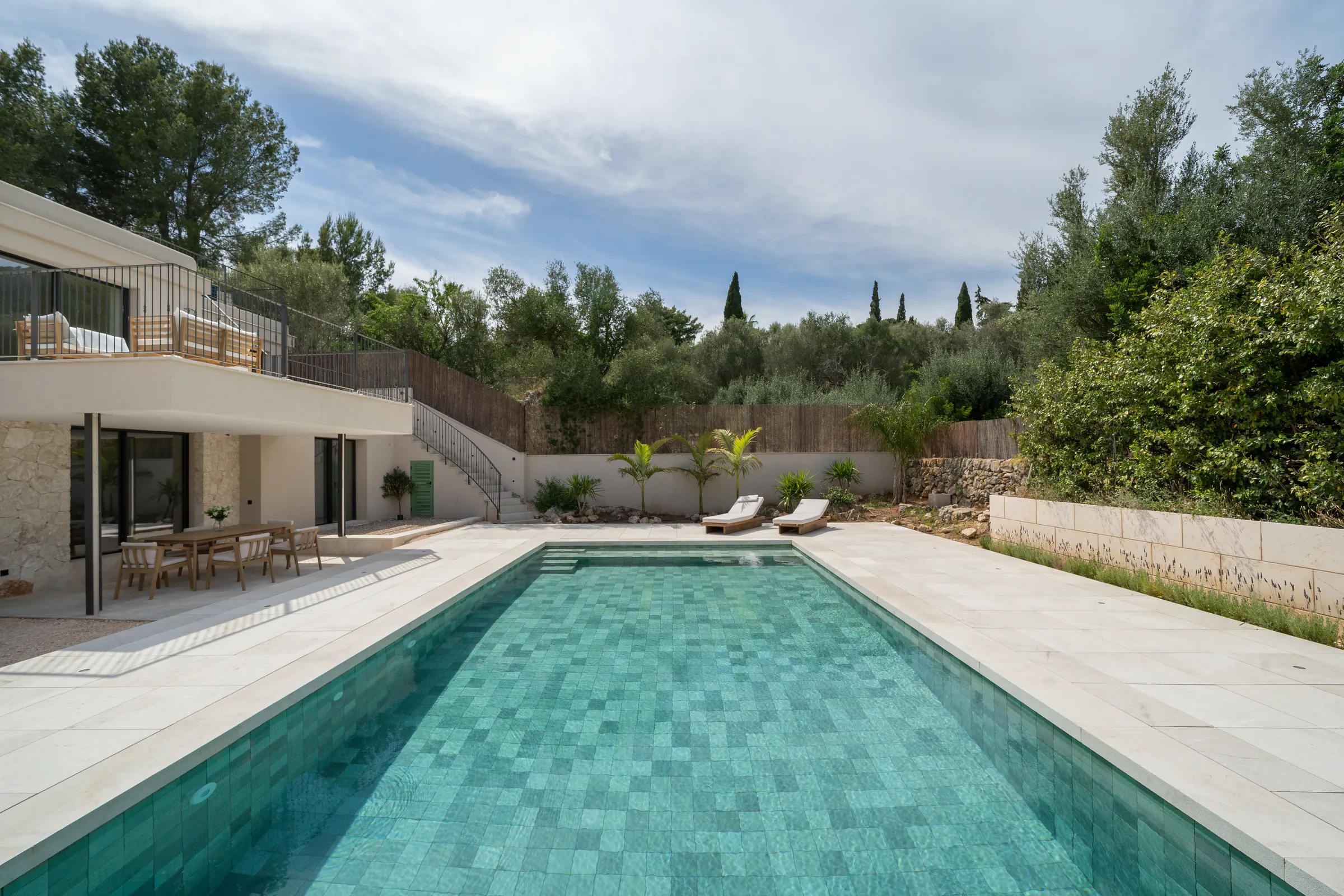
The answer to expect: specific projects, with locations and figures. At the villa in Es Capdellà (Calvià), for example, Top Mallorca extended and fully refurbished a 1974 house between 2025 and 2026: it now has 350 m² of built floor area on a 1,161 m² plot. Other Top Mallorca projects are in Santa Catalina (Palma), Cala Llamp and Port d'Andratx.
What insurance does the builder have, and who takes out the 10-year structural insurance?
Ask for the certificate of its current public liability policy, showing the insurer and the sum insured, and check that it covers the whole project. If you are hiring as a private individual, the company must tell you before you sign which insurance is required and who its insurer is (Ley 7/2014, art. 27).
The 10-year structural insurance (seguro decenal) is another of the guarantees on a new-build home: it covers structural damage for ten years and is compulsory (LOE, second additional provision). It is taken out by the client – if the project is yours, that means you – although it can be agreed that the builder takes it out on your behalf (art. 19). Without it, the declaration of new build deed (escritura de obra nueva) cannot be registered (art. 20), except in the case of a self-builder (autopromotor) of a single home for their own use.
For a renovation that substantially changes the structure, volume or use, the 10-year insurance is also needed to register the works with the Land Registry. This was established by the Directorate General for Legal Certainty and Public Faith (Dirección General de Seguridad Jurídica y Fe Pública) in its ruling of 30 May 2022.
The answer to expect: the public liability certificate, and who handles the 10-year insurance from the outset.
What does the builder do after the handover of the keys?
Handover is formalised in the acceptance certificate (acta de recepción), which you can sign with reservations: the defects are recorded, together with the deadline for putting them right (LOE, art. 6). If, within 30 days of being notified that the work is finished, you neither record reservations nor reject acceptance in writing, the works are deemed accepted, and the guarantee periods run from that point.
You also receive the Building Logbook (Libro del Edificio), with instructions for use and maintenance (art. 7). That maintenance matters: unless otherwise agreed, the LOE guarantees do not cover damage caused by a lack of proper maintenance (art. 19).
The answer to expect: a snagging plan with dates and someone to deal with any issues in the first year. Top Mallorca can go on looking after the house through its property maintenance in Mallorca service.
Building contract: what it should include and what to get in writing before you sign
Take this table to your meeting with each company: it sums up what to ask a builder and what to get in writing.
| Question | What to get in writing |
|---|---|
| 1. Is it registered with the REA, and who will carry out the work? | REA number, site manager and planned subcontractors |
| 2. What does the quote include? | Line items with quantities, exclusions and VAT |
| 3. How are changes handled? | Price and time impact of each change, signed by you before it goes ahead |
| 4. What schedule and what penalties? | Phases with milestones, a capped penalty and payments against certificates |
| 5. What guarantees does the work carry? | Commercial guarantee with its duration and scope |
| 6. Who is my point of contact? | Name, frequency of reports and language |
| 7. Will it work with my architect? | Coordination with the site management team |
| 8. What similar projects has it completed? | Two or three comparable projects, with figures |
| 9. What insurance does it have? | Public liability certificate and who handles the 10-year insurance |
| 10. What happens after handover? | Acceptance certificate, snagging plan and maintenance |
Choosing a builder in Mallorca with this list will not prevent the unexpected, but it does mean that each issue has someone responsible for it and a procedure to follow. If a company will not give you its REA number, does not itemise its quote or does not put changes in writing, you already have your answer. If you would like to go through these questions with your project in front of you, tell us about it and we will explain how Top Mallorca, builders in Mallorca, would approach your build.
Frequently asked questions
How do you choose a builder in Mallorca if you don’t live on the island?
Ask every company the same questions and insist on written answers: registration with the REA (Spain’s register of accredited construction companies), an itemised quote, a procedure for changes, a schedule and insurance. A builder that works for non-residents should give you a single point of contact and regular progress updates with photos. Pay by bank transfer and against certified work: Ley 7/2012 prohibits cash payments of €10,000 or more if you are an individual with no tax domicile in Spain, and of €1,000 or more if you have one.
How do you check whether a Mallorca builder is registered with the REA?
Using the public search tool of the Register of Accredited Companies (Registro de Empresas Acreditadas, REA) on the Ministry of Labour website: you choose the identifier type and enter the company’s tax ID (CIF) or its REA registration number; you can’t search by name. Registration is compulsory for every company hired or subcontracted on a construction project and is valid throughout Spain (Ley 32/2006, arts. 4 and 6). The search shows the company’s registered name, its address and whether the registration is active.
Is a quote for building work binding in the Balearic Islands?
Yes, if you are hiring as a private individual and you accept it in writing. The Balearic Consumer Protection Act (Ley 7/2014 de protección de las personas consumidoras de las Illes Balears, art. 18) requires a written quote with the final price broken down and taxes included, and makes the quote and any changes binding once accepted in writing. Unless it states another period, it is valid for at least 15 calendar days, and the company cannot pass its own calculation errors on to the client.
What guarantee comes with a home renovation in Mallorca?
It depends. If the renovation affects the whole building or substantially changes its structure, volume or use, it counts as building work (edificación) and Spain’s Building Act (Ley de Ordenación de la Edificación) applies: 10 years for structural damage, 3 for habitability and 1 for finishes, from acceptance. A partial renovation without structural work has no statutory guarantee period of its own: products carry a 3-year guarantee (Real Decreto Legislativo 1/2007, art. 120), and breach of contract can be claimed for 5 years (Código Civil, art. 1964).
Who takes out the 10-year structural insurance (seguro decenal) on a new house in Mallorca?
The client (promotor) takes it out, which for your own house means you, although it can be agreed that the builder does so on your behalf (Ley de Ordenación de la Edificación, art. 19). It is compulsory for residential buildings, and the premium must be paid by the time the works are formally accepted. The only exemption is for a self-builder (autopromotor) of a single home for their own use, who must take it out if they sell within ten years, unless the buyer releases them from it.
Am I liable for a builder’s debts to its workers on a project at my house in Mallorca?
No. Under Spain’s Workers’ Statute (Estatuto de los Trabajadores, art. 42.2), the owner of the works is not liable when the contract is solely for the construction or repair of their home, or when they do not commission the work as part of a business activity. Even so, it is worth checking that the builder and its subcontractors are registered with the REA, as Ley 32/2006 requires of every company working on a construction project.
Sources consulted (11)
- Ley 32/2006, reguladora de la subcontratación en el sector de la construcción (BOE, consolidated text)
- Public search of the Registro de Empresas Acreditadas (Ministerio de Trabajo y Economía Social)
- Ley 38/1999 de Ordenación de la Edificación (BOE, consolidated text as of 15 June 2022)
- Ley 7/2014 de protección de las personas consumidoras y usuarias de las Illes Balears (BOE, consolidated text as of 31 December 2022)
- Código Civil (BOE, consolidated text as of 3 January 2025)
- Ayuntamiento de Calvià: amendment to art. 23.8 of the ordenanza de ruidos y vibraciones, the noise and vibration by-law (BOIB no. 77, 8 June 2024)
- Ley 7/2012, art. 7: limits on cash payments (BOE, consolidated text)
- Real Decreto Legislativo 1/2007, texto refundido de la Ley General para la Defensa de los Consumidores y Usuarios (BOE, consolidated text as of 28 February 2026)
- Resolución de 30 de mayo de 2022 de la Dirección General de Seguridad Jurídica y Fe Pública (BOE no. 149, 23 June 2022)
- Colegio de Registradores: Estadística Registral Inmobiliaria, second quarter of 2026
- Real Decreto Legislativo 2/2015, Estatuto de los Trabajadores, art. 42 (BOE, consolidated text as of 3 October 2026)
Builders of high-end homes in Mallorca: new builds, refurbishments, restoration, Project Management and maintenance. About us.